News Story
Eight Fischell Institute Labs Participate in Maryland Day

On Saturday, April 25, 2026 the University of Maryland hosted Maryland Day, the university’s largest annual open house.
The event, which offers interactive demonstrations, performances, and workshops across campus to celebrate community, included eight exhibits hosted by institute-affiliated research groups.
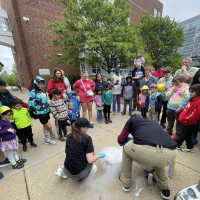 “Explosions, Ice Cream and Nanotechnology,” coordinated by Professor of Translational Engineering Chris Jewell’s lab, introduced attendees to gas laws and chemical reactions by inviting them to mix baking soda and vinegar in a bag to create mini eruptions. Lab members also showed how to make ice cream using liquid nitrogen and offered samples for attendees to taste.
The MEMS Sensors and Actuators Lab, led by Fischell Institute Fellow Reza Ghodssi, showcased its 3D printing capabilities by live-printing an Eiffel Tower model. The group also had a tiny, 3D-printed turtle which could be viewed under a microscope, and shared the lab’s work on ingestible capsule technologies for 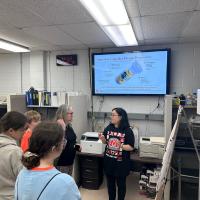 drug delivery.
Fischell Fellow Catherine K. Kuo’s lab taught visitors about the function and importance of tendons at “Tendons: Our Body’s Rubber Bands,” where participants built model hands using cardboard, straws and yarn to simulate tendon movement, with each strand controlling a finger. Once built, participants were invited to decorate and take home their hand models.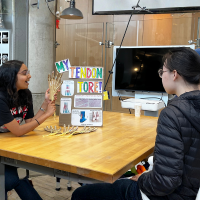
The Manufacturing Intelligence Research and Advanced Geometry Evaluation (MIRAGE) Lab, led by Fischell Fellow Davis McGregor, challenged participants to find hidden defects in 3D printed parts before an AI-powered camera could at “You vs. AI: The Defect Detective.” After finding the flaws, the parts were crushed to 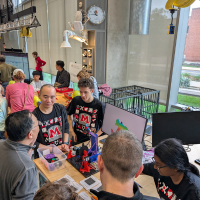 show why defects matter.
Fischell Fellow Yang Tao’s Bio-Imaging and Machine Vision lab showcased its "Autonomous Robot Systems” in the Maryland Robotics Center. A walk through the space allowed visitors a chance to see how the lab’s vision-guided robotic systems can replace labor-intensive manual processes by automating and optimizing tasks, such as selecting and packaging optimal white button mushrooms from a large group. 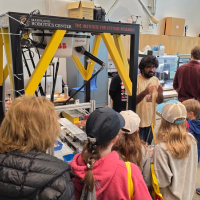
Affiliate Fellow Gregg Duncan’s Respiratory NanoBioengineering Lab offered insight into how lungs work at “The Lung Lab” — a booth where participants could create model lungs using balloons, cups, and straws. The booth also featured a Plinko-style game where children simulated the spread of influenza by aiming for “pandemic” or “infection” outcomes when dropping a ball into the game board. The booth also displayed a 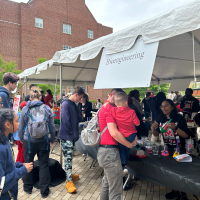 3D-printed nasal cast illustrating different regions of the nose.
The Laboratory for MicroTechnologies, run by Affiliate Fellow Elisabeth Smela, collaborated with Science, Technology and Society Director David Tomblin to host “Name That Smell.” At this stop, Maryland Day attendees could explore the roles of odors in the world through an interactive sniff activity. The booth also discussed the lab’s artificial nose research and invited visitors to consider real-world applications for handheld odor detection devices. 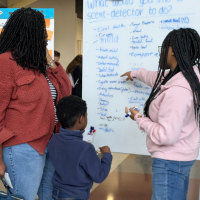
“Mobile and Magnetic Surgical Robots,” hosted by Affiliate Fellow Yancy Diaz-Mercado’s Collaborative Controls and Robotics Lab, demonstrated how coordinated robotics systems can perform complex tasks, including enabling a single user to control multiple robots around obstacles and 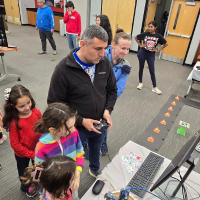 using magnetic fields to guide needles for surgical applications.
This year's Maryland Day offered 422 free events and drew approximately 80,000 visitors to campus, giving Fischell Institute researchers a broad audience to share their work with the next generation of scientists and engineers.
Published May 15, 2026
Related Stories
Stories / May 1, 2025
Fischell Institute Participates in Maryland Day 2025
Stories / May 3, 2024
Fischell Institute Participates in Maryland Day
Stories / October 22, 2026
Fischell Institute Intern Spotlight: Alexandra Tombleson

Stories / October 21, 2026
Get to Know Fischell Institute Community Member: Pablo Lozano

Stories / October 5, 2026
Fischell Institute Intern Spotlight: Kishore Krishnakumar

Stories / October 5, 2026
Fischell Institute Intern Spotlight: Jaehee Yi

Stories / September 22, 2026
Fischell Institute Intern Spotlight: Minh Nguyen

Stories / July 17, 2026
UMB Medical Device Aims to Improve Vascular Access Safety

Stories / June 11, 2026
Fischell Institute Welcomes 2026 Summer Research Interns

Stories / April 17, 2026
Fischell Institute Invests $150K Across Three Professional...
