News Story
Fischell Institute Womxn's History Month Spotlight: Kiyana N’Gouemo

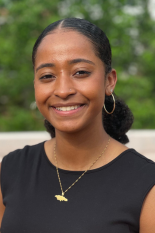
Kiyana N’Gouemo is a senior pursuing a Bachelor of Science in neuroscience. She works as an undergraduate researcher in the lab of Fischell Institute Affiliate Fellow and Department of Biology Professor Ricardo Araneda.
Her passion for science took shape in high school after participating in Project Lead the Way, a program that assists with college and career readiness through hands-on, project-based learning opportunities. The experience introduced N’Gouemo to foundational lab techniques and sparked her curiosity for how scientific concepts translate into discovery.
That early lab exposure ultimately led her to research at Maryland.
“Being at a large research institution made it possible for me to explore my interests early on and gain meaningful lab experience, which has been incredibly important in shaping my academic and career goals,” N’Gouemo said.
Now, having worked in Araneda’s lab for two years, N’Gouemo feels the experience has been especially enriching.
“I’ve learned and run a variety of behavioral assays, gaining hands-on experience and confidence in conducting experiments,” she said. “I’ve also developed skills in histological techniques like immunohistochemistry, which have deepened my understanding of neural circuits and how they relate to behavior.”
The Araneda Lab utilizes the body’s olfactory system, the network responsible for sense of smell, to better understand how neuromodulators like dopamine and serotonin regulate brain circuit functions and influence sensory processes. As a neuroscience major that had not previously explored olfactory research, N’Gouemo was drawn to the lab. She was particularly interested in understanding how neural regulation influences odor-guided behaviors and how neural circuits connect to behavior more broadly.
N’Gouemo’s research examines how social experiences shape odor-mediated behaviors and the underlying neural circuits in the olfactory bulb, the part of the olfactory system that processes information from receptors. She accomplishes this by studying the effects of social isolation on odor processing in juvenile male mice that are either group-housed or single-housed.
“What excites me most about this work is how it provides insight into the fundamental mechanisms linking social experience, sensory processing, and behavior,” N’Gouemo said. “Understanding these neural circuits could have broader implications for neurological disorders and age-related changes in sensory and social function, offering potential clues for how disruptions in neural networks may impact behavior in humans.”
She is currently writing her neuroscience honors thesis based on this research and will defend it this spring. N’Gouemo noted that the task has allowed her to integrate what she has learned while also contributing meaningfully to the lab’s ongoing research.
“Seeing how my work can connect to bigger questions in neuroscience and potentially make a difference for others is what makes it so meaningful,” she said.
N’Gouemo’s drive is shaped by her experiences as a Black woman in a male-dominated field and by the resilience and determination that her immigrant parents have demonstrated in making a life for themselves in America.
“I’m constantly aware of how few people who look like me have had the opportunities I now have,” N’Gouemo noted. “That awareness pushes me to work harder and embrace every chance to learn and grow.”
Looking ahead, N’Gouemo hopes to become a physician that works with children, particularly in a neurology-related field, where she can have a direct impact on people’s lives.
“I’ve fallen in love with how pediatric care is such a team effort, working closely with families, nurses, therapists and other specialists to provide the best care possible,” she said. “At the same time, I hope to stay involved in research and contribute to discoveries and treatments for neurological conditions. Being able to combine patient care with advancing scientific understanding is what excites me most about the future”
Outside of the lab, N’Gouemo enjoys reading, traveling and visiting museums.
Published March 6, 2026
Related Stories
Stories / March 13, 2026
Fischell Institute Womxn's History Month Spotlight: Paige...

Stories / March 13, 2025
Fischell Institute Womxn History Month Spotlight: Futoon...
Stories / March 13, 2025
Fischell Institute Womxn History Month Spotlight: Kimia...
Stories / March 29, 2024
Fischell Institute Womxn's History Month Spotlight: Samantha...

Stories / March 15, 2024
Fischell Institute Womxn’s History Month Spotlight: Sydney...
Stories / March 8, 2024
Fischell Institute Womxn’s History Month Spotlight: Proma...
Stories / March 1, 2024
Fischell Institute Womxn’s History Month Spotlight: Sidney...
Stories / February 27, 2026
Fischell Institute Black History Month Spotlight: Valinteshley...

Stories / February 27, 2026
Fischell Institute Black History Month Spotlight: Latrell Cook

Stories / February 26, 2025
Fischell Institute Black History Month Spotlight: Jordyn Allen